
Land Management Search Results
Land Management Search Results
Displaying:
1921 - 1940 of 3403
To narrow down your search results use the filters at left to find Contacts, active Projects, specific resource Formats, News & Events or, for example view only resources from a specific Organization, or about specific Disturbance Types.
Oak Wilt
Resource
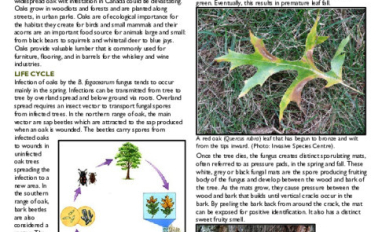
Oak wilt is a tree disease caused by the fungus Bretziella fagacearum. The fungus is widespread throughout the eastern United States and, as of 2021, found within 600 m of the Canadian border near...
Observations on the Dispersal of Saline Groundwater in the Beaver Creek Diversion System, 1976-1978
Resource
Emphasis is placed on processes influencing temporal and spatial patterns in circulation, stratification and saline water distributions. Owing to its density, the high salinity effluent tends to sink

Official Launch of the SIP Exchange (SIPex)
News
Organization
Forest practitioners across British Columbia now have a powerful new tool to support innovation and adaptive management in forestry with the official launch of the SIP Exchange (SIPex) — a user...

Oil and Gas Drilling Waste Management Considerations by Public Lands Division Staff, Department of Forestry, Lands and Wildlife in Alberta
Resource
In 1975, the Energy Resources Conservation Board, the Department of Environment, the Department of Energy and Natural Resources and industry developed drilling fluid disposal guidelines to provide...
Oil Sand Overburden Characterization Within the Mine Area of Syncrude Lease No. 17 for Reclamation of Spent Oil Sand
Resource
Oil sand overburden materials within Syncrude Lease No. 17 were sampled and analyzed with the intent of isolating mineral materials overlying lean oil sand which may be useful in reclamation
Oil Sands Clay Fines: Can they be Reclaimed as Productive, Self-Sustaining Wetlands?
Resource
The Clark hot water process currently used for extracting bitumen from the Athabasca oil sands results in large volumes of clay fines containing small amounts of residual bitumen. One possible way of...
Oil Sands Development Contributes Polycyclic Aromatic Compounds to the Athabasca River and its Tributaries
Resource
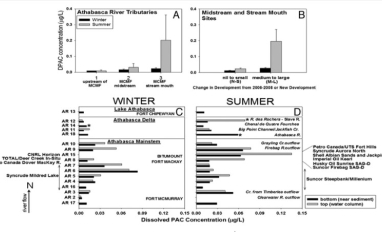
For over a decade, the contribution of oil sands mining and processing to the pollution of the Athabasca River has been controversial. We show that the oil sands development is a greater source of...
Oil Sands Mining Reclamation Challenge Dialogue – Report and Appendices
Resource
While the Challenge Paper intended to focus on a few key aspects of the reclamation challenge for mining in the oil sands area, it ended up provoking a wide range of reactions
Oil Sands Rec1amation – An Overview of Suncor’s Program
Resource
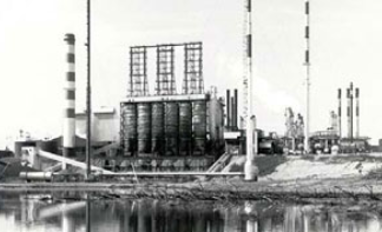
Commercial production of synthetic crude oil from the Athabasca Oil Sands began in 1967 in north-eastern Alberta. Suncor Inc., then known as Great Canadian Oil Sands Ltd., began the development of...
Oil Sands Reclamation: A Study Integrating Mining, Tailings Disposal and Reclamation. Volume I - Text.
Resource
Provides comprehensive review of the technical problems facing future oil sands developments and suggests options helpful in formulating oil sands mining, tailings disposal and reclamation plans
Oil Sands Reclamation: A Study Integrating Mining, Tailings Disposal and Reclamation. Volume II - Drawings
Resource
A total of sixty-eight drawings show the mining, tailings disposal and reclamation of the twelve mine designs developed in the study (see Volume 1).
Oil Sands Reclamation: A Study Integrating Mining, Tailings Disposal and Reclamation. Volume III – Yearly Cost Summaries
Resource
Yearly cost summaries for the 12 mine plans analyzed in the study (Volume 1) for 35 years. Activities in each mine are grouped into 6 cost centres, which are further divided into cost sub-centres.
Oil Sands Remediation – What’s the (end) Point?
Resource
Remediation professionals, regulators, industry and stakeholders must begin discussions to resolve uncertainty around oil sands COPCs so that efforts can be focused on solving the “real” problem
Oil Sands Research and Information Network
Project
Organization:
The Oil Sands Research and Information Network (OSRIN) is a now closed (2009-2014) project of the University of Alberta’s School of Energy and the Environment (SEE) It was a university-based...
Oil Sands Research and Information Network: Creating and Sharing Knowledge to Support Environmental Management of the Mineable Oil Sands
Resource
The Oil Sands Research and Information Network (OSRIN) is a university-based, independent organization that compiles, interprets and analyses available knowledge about managing the environmental...