Ressources de Gestion des Terres
Ressource
Author(s)
Alberta Biodiversity Monitoring Institute (ABMI)
Resource Date:
January
2020
Linear features, including seismic lines, pipelines, transmission lines, roads, railways, and trails are pervasive in Alberta’s boreal forest and have been implicated as a primary factor leading to...
Ressource
Author(s)
Fuse Consulting Ltd.
Swamp Donkey
FPInnovations
Resource Date:
January
2020
Restoration Innovation Roadmap Phase 2: A summary of opportunities to advance innovation for linear restoration within woodland caribou habitat Restoration of woodland caribou habitat has received...
Ressource
Potential for using satellite imagery to determine water quality parameters in the southwest end of Lake Athabasca and provide a mathematical model capable of simulating the circulation patterns
Ressource
Author(s)
Hal Hamilton
M.V. Thompson
Linda Corkum
Report overviews major water quality patterns and trends for the Athabasca River and its major tributaries from 1970 to 1985 and compares water quality data with surface water quality objectives
Ressource
Author(s)
Hal Hamilton
Ron Wallace
D. Westlake
Julia Foght
Barry Taylor
Steve Hrudey
Relationship between hydrocarbons present naturally, or introduced due to surface oil sands mining and upgrading activities, and their potential bioaccumulation and tainting of the commercial fishery
Ressource
Author(s)
Anne McIntosh
Bonnie Drozdowski
Dani Degenhardt
Chris Powter
Christina Small
John Begg
Dan Farr
Arnold Janz
Randi Lupardus
Delinda Ryerson
Jim Schieck
Scientifically robust monitoring protocol to enable consistent assessment of ecological recovery of physical, chemical, and biological indicators at certified reclaimed well pads on grasslands.
Ressource
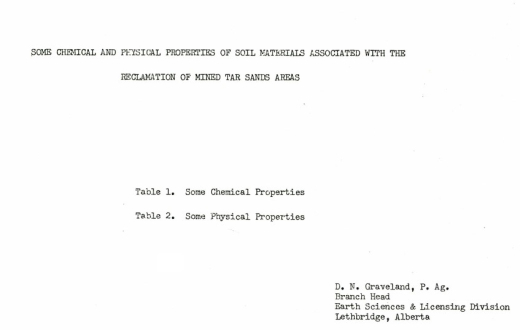
This document consists of two tables providing chemical and physical properties of soil, peat, overburden, spent sand and lean tar sand from Syncrude and Suncor.
Ressource
Nearly 76% of all water used in the basin in 1981 was obtained from the river, 22% from major tributaries and other surface sources, and the remaining 2% from groundwater
Ressource
Author(s)
C.S. Davis
P. Fellin
D. Stevens
S. Todd
K. Heidorn
Since the determination of the environmental impact of two major pollution sources on precipitation quality was a primary project objective, poor collection efficiencies did not satisfy the objective
Ressource
Author(s)
Energy and Natural Resources
Energy Resources Conservation Board
Alberta Oil Sands Technology and Research Authority (AOSTRA)
Overview of the oil sands, current commercial developments, experimental work, an overview of Fort McMurray and the role of government agencies in development and management of oil sands.