Ressources de Gestion des Terres
Ressource
Author(s)
Athabasca Tar Sands Corridor Study Group
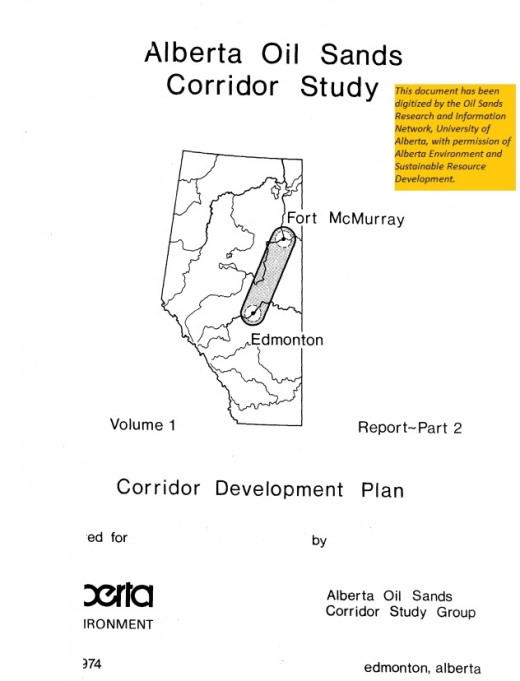
Transportation corridor connects oil sands resources of the Athabasca area to a new major provincial terminal serving as a central hub for additional corridors radiating out to industrial facilities
Ressource
Author(s)
Athabasca Tar Sands Corridor Study Group
There has been much discussion and considerable debate regarding feasibility of combining multiple pipelines, electric-power transmission lines, highways, railroads and communication systems in a
Ressource
Treatment and disposal procedures for oil sands tailings, as well as for clay tailings from other industries, are discussed and general background to the disposal problems is provided
Ressource
Author(s)
Alberta Health, Health Surveillance
Develop a data collection method for personal/population exposure assessment of exposure to sulphur dioxide, nitrous oxides, ozone, volatile organic compounds, particulates, and heavy metals
Ressource
Author(s)
Alberta Health, Environmental Health Services Division
Water quality in the Athabasca River and tributaries was found to be generally acceptable throughout the winter of 1969/70. However, relatively high odor and colour values were observed on occasions
Ressource
Author(s)
Alberta Health, Environmental Health Services Division
presents the summary of water quality in the Athabasca River during six sampling surveys (including a site at Fort McMurray, Tar Island, above G.G.O.S.)
Ressource
Author(s)
Alberta Health, Environmental Health Services Division
On May 30, 1968 G.C.O.S requested permission to discharge 110 x 106 ft3 of effluent from the sands tailings pond at the Fort McMurray site into the Athabasca River during periods of high river flow
Ressource
Author(s)
Alberta Health and Wellness
Describes the population and personal distribution of exposure to airborne chemicals and particulates in the city of Fort McMurray,
Ressource
Author(s)
Alberta Health and Wellness
Study was designed to assess exposure and associated health effects by direct measurement of personal exposure, direct measurement of biomarkers, and daily logs of a participant's activities
Ressource
Examines differences in health outcomes across the province and compares the Northern River Basin Study area with the other areas of the province and examines possible relationships between health out