
Land Management Search Results
To narrow down your search results use the filters at left to find Contacts, active Projects, specific resource Formats, News & Events or, for example view only resources from a specific Organization, or about specific Disturbance Types.
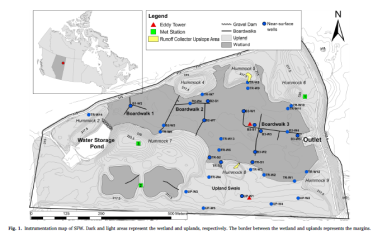
The Hydrochemical Evolution of a Constructed Peatland in a Post-mining Landscape Six Years After Construction
Resource
The Hydrology of Lease 17: A Report of Studies Completed in the Year 1973
Resource
The Impact of Fuel Treatments on Wildfire Behavior in North American Boreal Fuels: A Simulation Study Using FIRETEC
Resource
The Impact of Saline Waters upon Freshwater Biota: (A Literature Review and Bibliography)
Resource
The Importance of Continuous Dialogue in Community-Based Wildlife Monitoring: Case Studies of Dzan and łuk Dagaii in the Gwich’in Settlement Area
Resource
The Influence of Energy Development on the Ecology of the Ferruginous Hawk in the Western Canadian Grassland Ecosystems
Resource
The Influence of Forest Harvesting Activities on Seismic Line Tree and Shrub Regeneration in Upland Mixedwood Boreal Forests
Resource
The Influence of Oil Sands Development on Trapping in the Fort McMurray Region
Resource
The Influence of Postfire Recovery and Environmental Conditions on Boreal Vegetation
Resource
The Influence of Uranium Mine Tailings on Tree Growth at Elliot Lake, Ontario
Resource
The Interactive State of Mass Timber in Canada (SMTC) Dashboard
Resource
The Long-term Impact of Pipeline Construction on Solonetzic Mixed Prairie
Resource
The Metabolism of Selected Organic Compounds by Microorganisms in the Athabasca River
Resource
The Million Dollar Mistake
Resource
The Multiple Toxicity of Vanadium, Nickel, and Phenol to Fish
Resource
The Multisource Vegetation Inventory (MVI): A Satellite-Based Forest Inventory for the Northwest Territories Taiga Plains
Resource
Wall-to-wall 30 m raster maps of broad forest type, stand height, crown closure, stand volume, total volume, aboveground biomass, and stand age were created for a ~400,000 km2 area, validated with independent data, and generalized into a polygon GIS layer resembling a traditional FI map. The MVI project showed that a reasonably accurate FI map for large, remote, predominantly non-inventoried boreal regions can be obtained at a low cost by combining limited field data with remote sensing data from multiple sources.