Ressources de Gestion des Terres
Ressource
Two 3-day small mammal trapping periods were conducted on 2 woodland areas. Surveys of species composition and density of ground cover and saplings, and of the levels of small mammal damage completed
Ressource
Author(s)
Margaret Sawatzky
Amanda Martin
Lenore Fahrig
Resource Date:
January
2019
This resource is available on an external database and may require a paid subscription to access it. It is included on the CCLM to support our goal of capturing and sharing the breadth of all...
Ressource
Author(s)
Joseph Bennett
Sean Maxwell
Amanda Martin
Iadine Chadès
Lenore Fahrig
Benjamin Gilbert
Resource Date:
February
2018
Abstract: The question of when to monitor and when to act is fundamental to applied ecology and notoriously difficult to answer. Value of information (VOI) theory holds great promise to help answer...
Ressource
Author(s)
Andrew Moraga
Amanda Martin
Lenore Fahrig
Resource Date:
April
2019
Abstract: Context To detect an effect of landscape context on a species’ response, the landscape variables need to be measured within the appropriate distance from the species’ response, i.e. at the...
Ressource
Author(s)
Lenore Fahrig
Víctor Arroyo-Rodríguez
Joseph Bennett
Véronique Boucher-Lalonde
Eliana Cazetta
David Currie
Felix Eigenbrod
Adam Ford
Susan Harrison
Jochen Jaeger
Nicola Koper
Amanda Martin
Jean-Louis Martin
Jean Paul Met
Resource Date:
December
2018
This resource is available on an external database and may require a paid subscription to access it. It is included on the CCLM to support our goal of capturing and sharing the breadth of all...
Ressource
Resource Date:
February
2018
This resource is available on an external database and may require a paid subscription to access it. It is included on the CCLM to support our goal of capturing and sharing the breadth of all...
Ressource
Author(s)
M.A. Giles
J.F. Klaverkamp
S.G. Lawrence
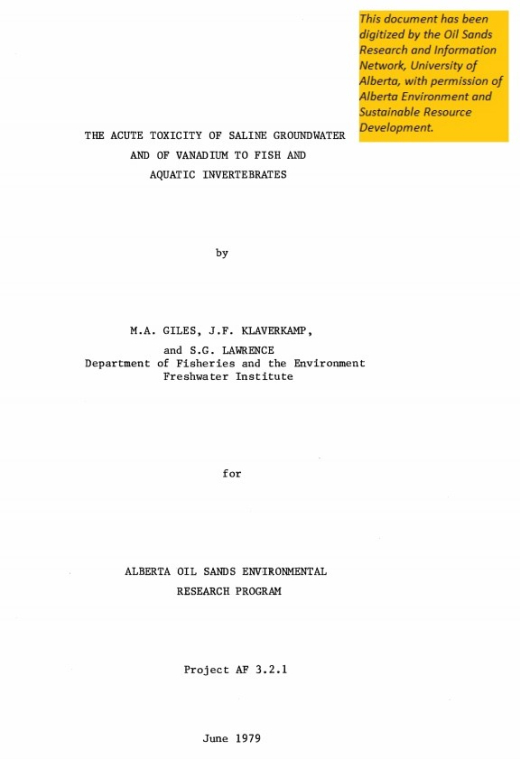
Purpose of this project was to provide detailed information regarding the acute toxicity this mine depressurization water to both fish and invertebrates.
Ressource
Author(s)
F.F. Gilbert
S.A. Brown
M.E. Stoll
Annotated bibliography contains 776 entries grouped under the species: muskrat, beaver, mink, and otter
Ressource
Live trapping and tagging of the four study species, beaver (Castor canadensis), muskrat (Ondatra zibethicus), mink (Mustela vison), and otter (Lutra canadensis), were conducted while the study areas
Ressource
Author(s)
John Gartrell
H. Krahn
F.D. Sunahara
From 1961 to 1979, there was an abrupt transition from the economy reliant on traditional activities such as hunting, trapping, fishing, and transportation to an industrial economy based on oil sands