Ressources de Gestion des Terres
Ressource
A total of 14 species was observed on the study plots in 72 separate sightings. The gray jay was the most common species (57 sightings), followed by hoary and common redpolls (33 sightings), willow p
Ressource
Author(s)
E.J. McCullough
Brian Reeves
This assessment was designed to locate and assess prehistoric and historic sites which might be present in the area between the Beaver and MacKay Rivers. Three prehistoric sites were recorded
Ressource
Author(s)
B. McMahon
Peter McCart
A. Peltzner
G. Walder
Study designed to determine whether groundwater from the mine area is toxic and, if so, the concentrations at which this toxicity is expressed. Species, including fish and aquatic insects was tested
Ressource
Author(s)
R.L. & L. Environmental Services Ltd.
A.A. Aquatic Research Ltd.
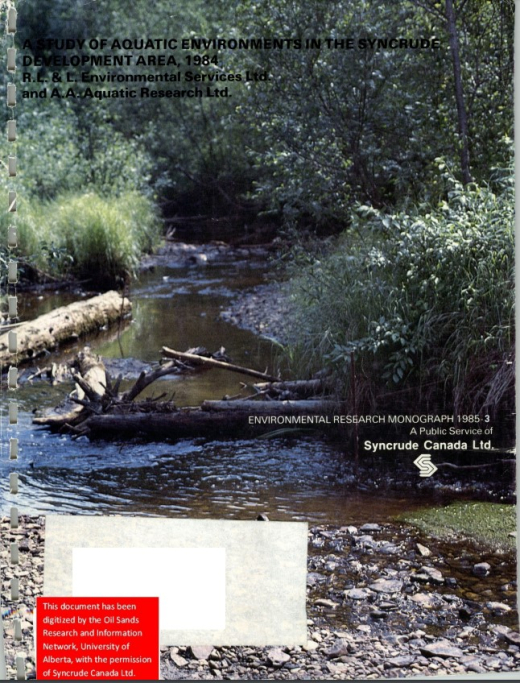
Characterize and re-define aquatic habitats. Aquatic habitat, water quality, flora, and fauna of the aquatic systems in the development area are typical of those found in the oil sands region
Ressource
The area does not appear to include any rare or endangered species and the habitats in the area are common to a large portion of Northern Alberta, therefore area is not critical to any wildlife specie
Ressource
Author(s)
Everett Peterson
Allan Levinsohn
Black Spruce - Labrador Tea was the dominant vegetation type, making up 35.0% of the 9,250 ha study area. The 2nd most abundant type was Aspen - White Spruce (26.0%) and the 3rd was White Spruce – Asp
Ressource
Entomological reconnaissance study of Syncrude Lease #17 area to gain preliminary data and to examine the potential of insects as biological monitors of environmental changes resulting from Syncrude
Ressource
In 1980, the tailings pond was a highly stratified waterbody with a low density, well mixed surface zone (0-6 m) overlying a high density deep water zone (>10 m) where mixing is slow
Ressource
Soils were inspected and described at 413 sites. Soils of the Luvisolic, Brunisolic, Gleysolic, Cryosolic and Organic Orders were recognized and characterized. depth of peat is
Ressource
Author(s)
Len Knapik
Katherine Bessie
E. Richardson
Soil patterns in the area are generally quite simple, with large homogeneous soil units. The major criteria for differentiating soils are parent material and drainage conditions.