
Established in 2020, the Population Management Working Group (PMWG), part of the National Boreal Caribou Knowledge Consortium (NBCKC), was a forum to share and generate new knowledge regarding population-based management actions for boreal caribou across Canada. The PMWG sought to bring together the best available information and help inform actions by management practitioners across Canada to best support caribou conservation and recovery programs. The PMWG and the NBCKC were supported by a central secretariat within Environment and Climate Change Canada. As coordination of the group by ECCC comes to an end in March 2026, the group is exploring ways that it might continue. Any updates related to the PMWG will be posted here.
| Goal | |
|---|---|
| All aspects of caribou recovery can be controversial, including habitat protection that affects local resource-based economies, and population-based management actions that may be less acceptable to others. The focus of this group was to advance understanding of management actions and their potential value to caribou conservation and recovery.
The goals of the PMWG were:
|
| What the Group Did | |
|---|---|
The PMWG advanced their goals by meeting on a bi-monthly basis as a network of adaptive management practitioners. The PMWG established a forum that brought members together to coordinate, share and generate new knowledge regarding population-based management actions for boreal caribou across Canada. The following tenets guided the work of the PMWG:
The PMWG moved into Phase 2, which is to inform the establishment of a network of adaptive management projects for boreal caribou across their range. This network would consist of pilot areas identified across a gradient of environmental variables. This work would include the long-term monitoring of these ranges through partnerships established by the network. |  |
| PMWG Members: Unique Structure | |
|---|---|
The PMWG was organized into two groups: A core group and an extension group. The core group membership consisted of individuals directly engaged in management actions or evaluating the outcome of these actions, for caribou recovery. The core group met regularly to maintain a community of practice, with an emphasis on “real-time results and information exchange”. The extension group had a broader membership than the core group and was open to individuals and representatives of organizations who were engaged in caribou conservation or hold knowledge regarding caribou, including representatives from Indigenous organizations, academia, industry, and non-governmental organizations. Meetings between the core and extension groups improved transparency, understanding, and rationale for management practices and provide an opportunity for diverse perspectives to be conveyed. | 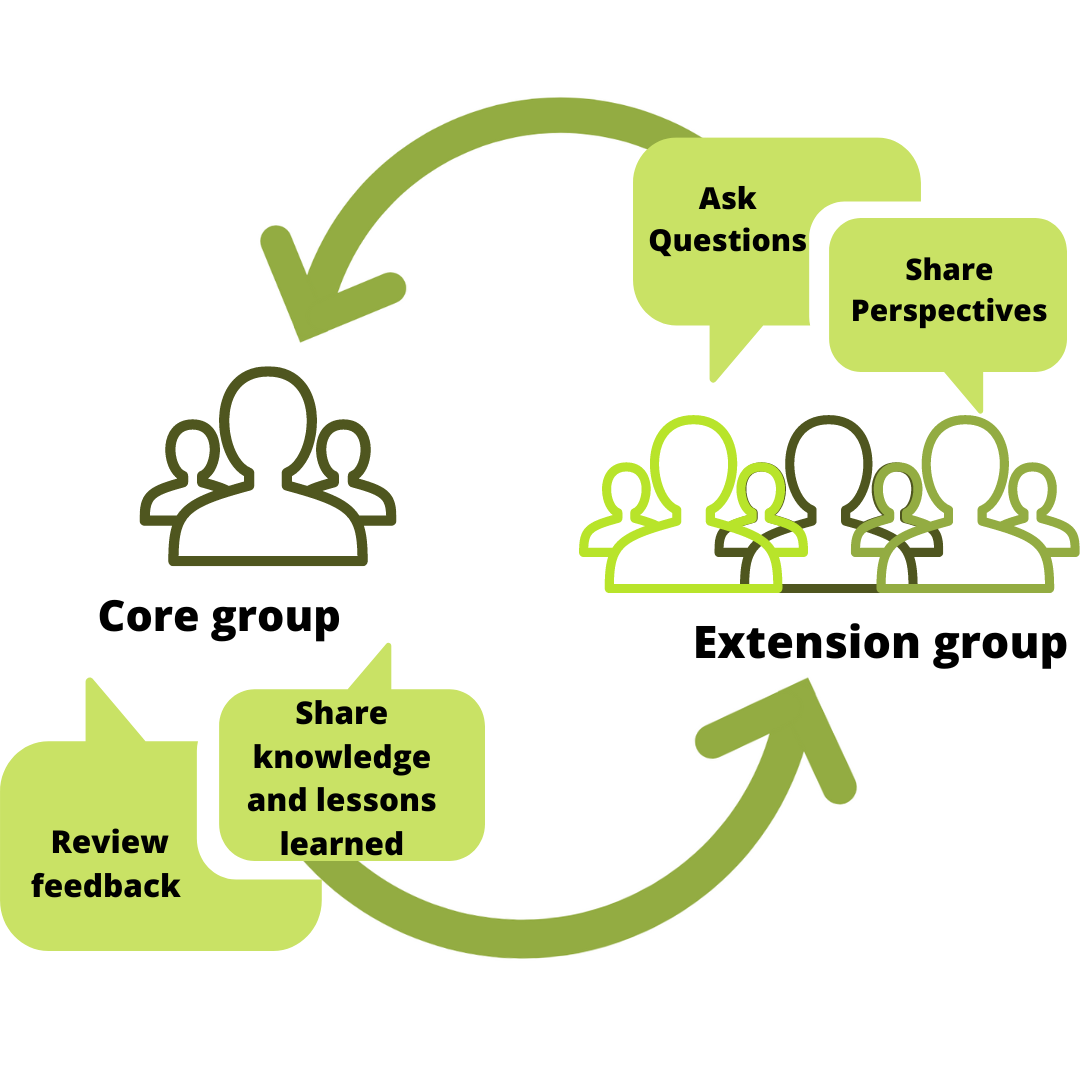 The relationship between the core group and extension group of the PMWG, where green arrows represent a feedback loop of communication. Ideas from one group were mulled over, considered, and possibly replied to by the other group. |
Between the core and extension groups, The PMWG's membership included ~40 members representing Federal, Territorial, and Provincial governments, Indigenous organizations and communities, industry, ENGOs and academia.